
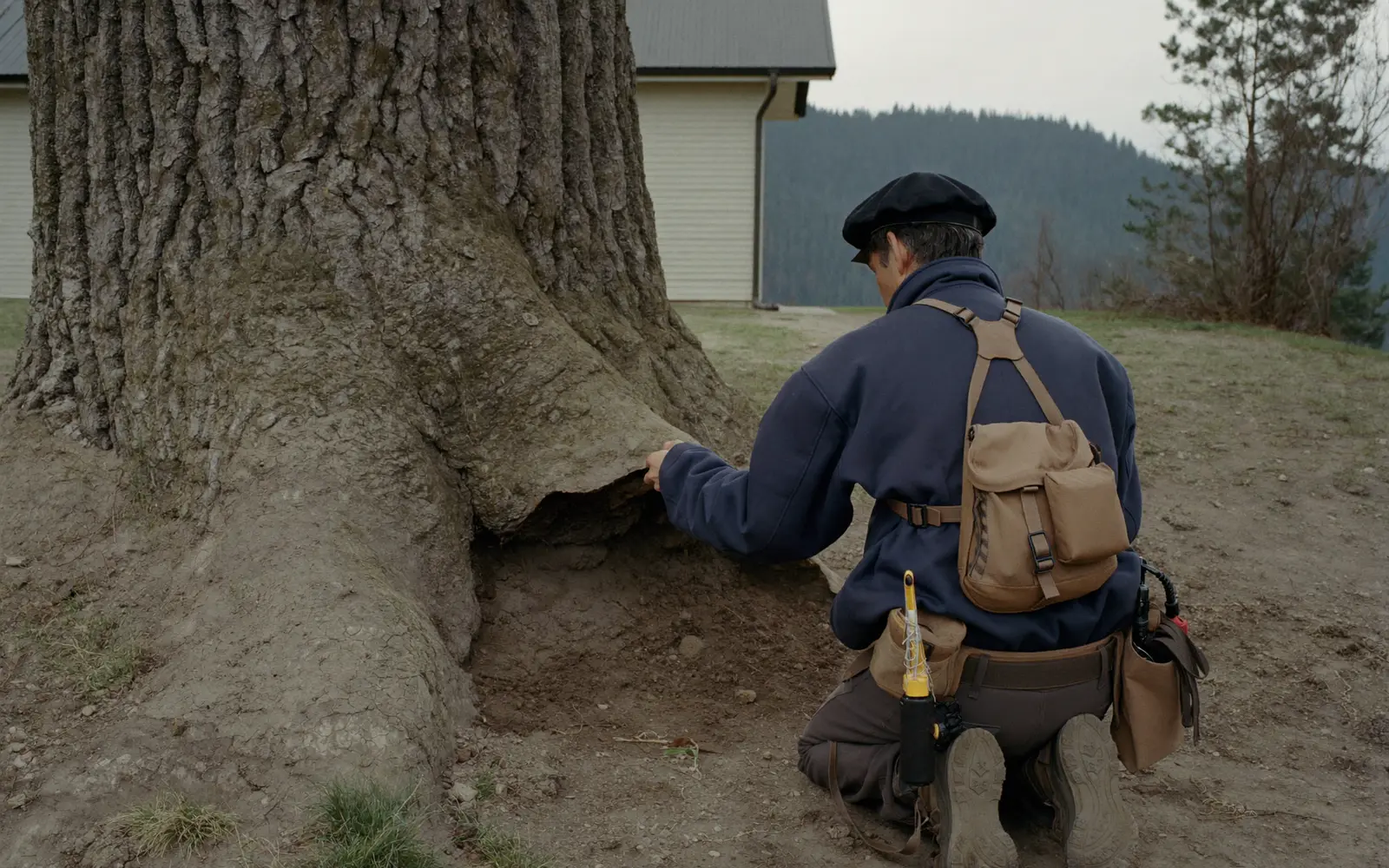
In Kirkland, being a hazard or nuisance tree is what lets a tree come down when the free notification can’t be used: past your yearly allowance, in a buffer, on the shoreline, under a covenant. That label needs proof. Kirkland Sentinel Tree Care helps you find out whether the tree really is a hazard, and what to do if it isn’t.
Signs a tree may be a hazard
- A new lean, or soil cracking and heaving on the side away from the lean
- Conks or mushrooms at the base or on the trunk
- Cracks and seams, swelling, flat or sunken areas on the trunk
- A weak fork: two trunks with bark pinched between them
- Dead, broken or hanging branches over a roof, driveway or play area
- Root damage from trenching, paving or a grade change
- Poor taper or a small live crown, typical of trees left after nearby clearing
What the city needs to see
A hazard or nuisance removal needs a Tree Removal Permit ($600 + 3.5%), a replanting plan and an arborist report that:
- records species, DBH, health, structure and defects, with photos
- uses the ISA TRAQ tree risk method: likelihood of failure, likelihood of impact, consequences
- explains how the tree meets Kirkland’s hazard definition, KZC 95.10(15)(b)
- gives an overall risk rating with mitigation options, and recommends removal only when pruning or moving the target can’t reduce the risk
The city won’t accept a bare ISA hazard evaluation form, or a crew’s quote, as an arborist report. Details: arborist reports.
If it’s not a hazard
Plenty of scary-looking trees are sound. Options before removal:
| Concern | Alternative |
|---|---|
| Weak fork or split | Cabling and bracing |
| Heavy limbs over the roof | End-weight reduction, roof clearance |
| Dense crown in wind | Crown thinning (under 25%) |
| Uncertain decay | Level 3 assessment: resistance drill, sonic tomography, root-crown excavation |
| Slowly declining | Monitor yearly, mulch, water in drought |
Nuisance trees
A nuisance tree is one causing documented damage: a root lifting the foundation, cracking the driveway or clogging the side sewer, where reasonable fixes like root pruning have failed or aren’t possible. Photos and repair estimates go in the report.
Worried a tree might fail? Get it assessed before storm season.
(425) 000-0000Common questions
What is a hazard tree in Kirkland?
A tree, or part of one, that a qualified arborist finds likely to fail and hit a target such as a house, driveway, play area or road, where pruning or moving the target can't bring the risk down to an acceptable level. Kirkland's definition is in KZC 95.10.
What is a nuisance tree?
A tree causing real, documented damage to property, such as lifting a foundation, cracking a driveway or damaging a sewer line, that can't be fixed by reasonable means. Photos of the damage belong in the arborist report.
Can I cable a tree instead of removing it?
Often, yes. Kirkland asks arborists to consider alternatives such as pruning, cabling, bracing and monitoring before recommending removal. Cabling a split trunk or weak union can keep a tree you like for years.