
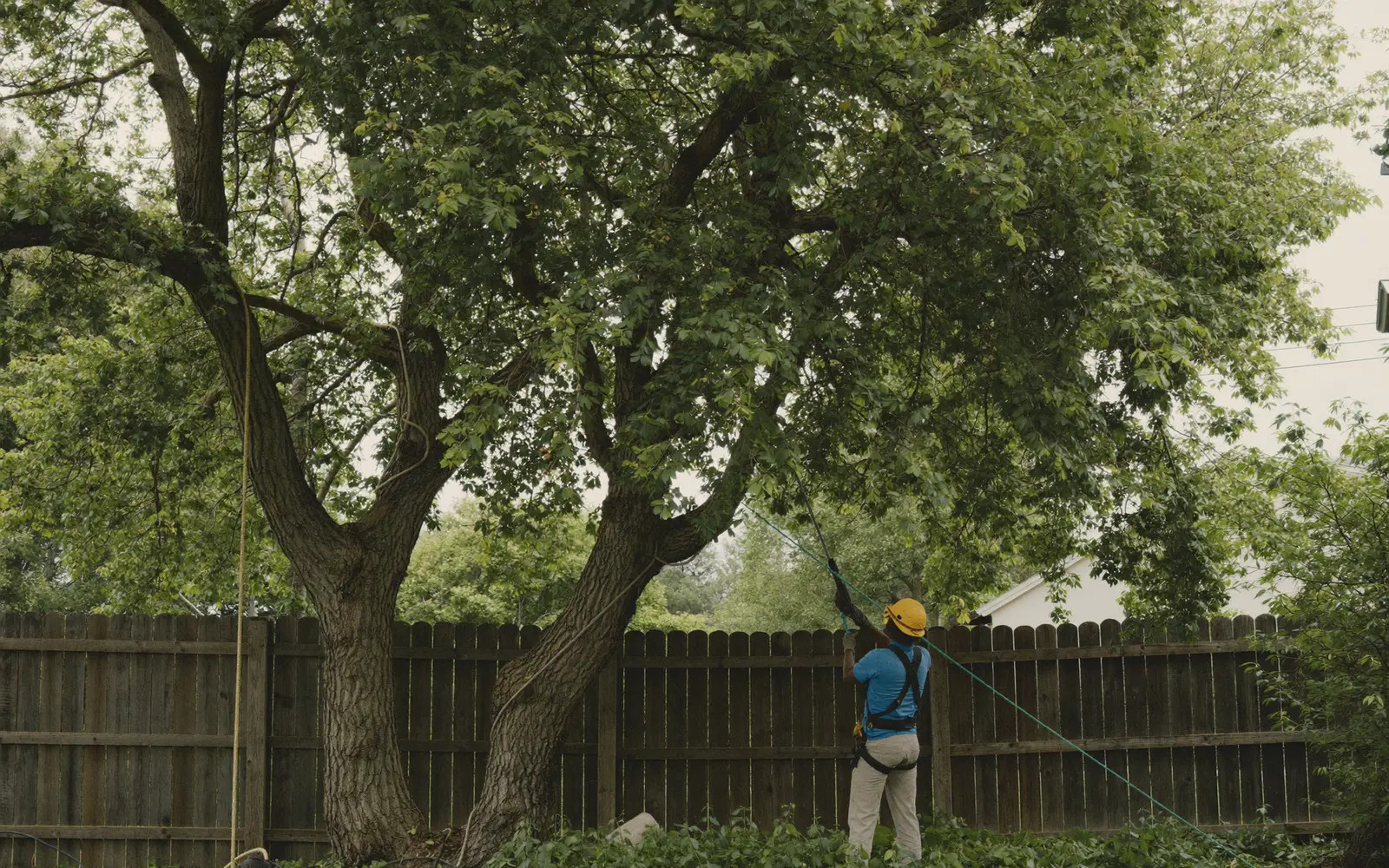
Most trees in Kirkland don’t need to come down, they need to be lighter, cleaner and off the roof. Kirkland Sentinel Tree Care prunes to ANSI A300 standards and inside the city’s rules: never topped, and never more than 25% of the live crown.
What pruning fixes
| Problem | Pruning type | Result |
|---|---|---|
| Wind catches a dense conifer | Crown thinning | Wind passes through; less sail effect in storms |
| Limbs over the roof, gutters full | Roof clearance / crown raising | 6–10 ft clearance, fewer needles in gutters |
| Dead branches in the canopy | Crown cleaning (deadwood) | Nothing heavy falls in the next storm |
| Long, heavy maple limbs | End-weight reduction | Shorter levers, lower break risk |
| No light in the yard | Selective thinning | Dappled light without stripping the tree |
| A blocked view | View pruning | A window through the tree, not a topped stump |
The 25% rule, and why it matters
Kirkland says pruning more than 25% of a tree’s live canopy can be treated the same as removing it, which brings in the notification, permit and enforcement rules. Topping is banned outright. In practice, good arborists take far less: 10–20% on a healthy mature tree, spread over several years if more is needed.
Where pruning needs permission
Ask the city first (service request “Critical Area Tree Pruning Request”, or 425-587-3600) when the tree is:
- in a wetland, stream or steep-slope buffer, common in Juanita and on Finn Hill ravines
- in the Lake Washington shoreline setback
- inside the Holmes Point Overlay
- protected by a Grove Covenant, Tree Preservation Covenant or NGPE
The city may ask for a pruning plan from a certified arborist. We can write it.
Conifers vs. broadleaf trees
Douglas firs and redcedars don’t regrow from bare wood, so cuts must leave live foliage on every branch. Lion-tailing (stripping inner branches, leaving tufts at the ends) makes them more likely to break, not less. Bigleaf maples resprout hard after big cuts, so a light, regular touch beats one heavy pruning. Pacific madrones dislike pruning at all; remove only dead or dangerous wood.
Hedges and small trees
Laurel, arborvitae and Leyland cypress hedges get trimmed on the same visit. Note that hedge removal can’t go through the free notification, so ask before taking a hedge out entirely.
When to book
- August–October: storm-prep thinning and deadwood on conifers, before the windy season
- November–February: structural pruning on dormant deciduous trees
- Any time: clearing branches from roofs, chimneys and wires (wires: see power lines)
Want branches off the roof before winter? Book pruning in early fall.
(425) 000-0000Common questions
Do I need a permit to trim trees in Kirkland?
Not for normal pruning on private property. You do need the City's permission first if the tree is in a critical area or its buffer, the shoreline setback, the Holmes Point Overlay, or under a covenant or Native Growth Protection Easement.
Why is tree topping banned in Kirkland?
Topping removes most of the foliage, starves the tree, leaves big wounds that decay, and triggers weak new shoots that break easily. Kirkland prohibits it and can treat a topped tree as an unpermitted removal.
How much can I safely cut off a tree?
For a mature tree, a quarter of the live crown is the most Kirkland allows in one go, and good arborists usually take far less, often 10 to 20 percent. Removing more can count as tree removal under the city code.
What is the difference between trimming and pruning?
People use them interchangeably. Arborists usually say pruning for selective cuts that shape and strengthen a tree, and trimming for keeping hedges and small branches neat. On a big tree, you want pruning.
When is the best time to prune in Kirkland?
Late fall to late winter for most deciduous trees, late summer to early fall for storm-prep work on conifers. Avoid heavy maple pruning in early spring when sap is running, and avoid pruning during bird nesting if you can.