
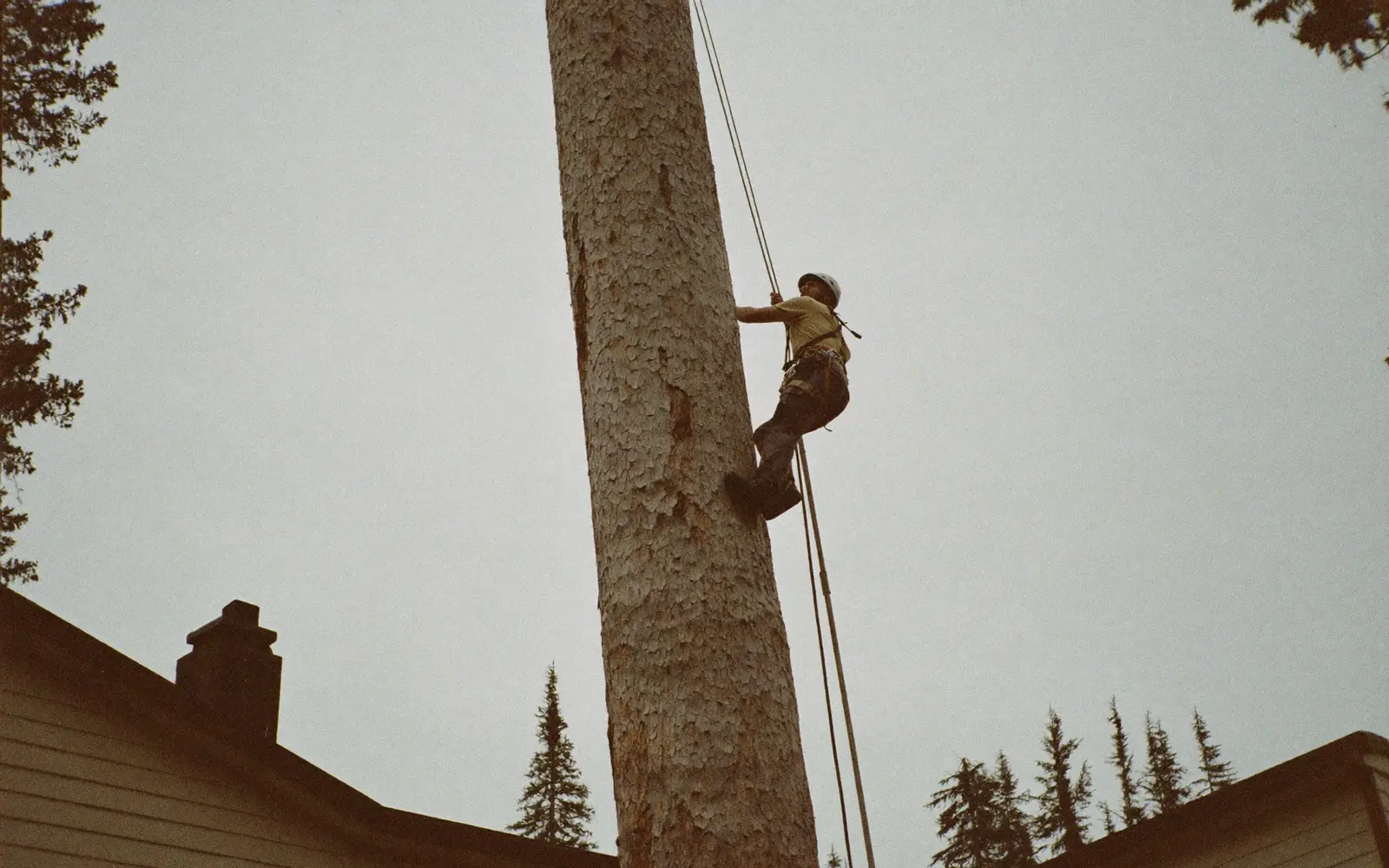
Douglas firs, western redcedars and western hemlocks are why Kirkland looks the way it does, and why removing one is a specialist job. A 120-foot fir weighs many tons, stands 30 feet from the house and leans just enough to worry you. Kirkland Sentinel Tree Care takes these trees down piece by piece, with nothing dropped on roofs, lawns or neighbours.
Why big conifers come out
- Root rot. Laminated root rot kills Douglas firs from below; the tree can look green until it tips over.
- Wind exposure. A fir that grew up in a stand is suddenly alone after nearby clearing, and its roots never anchored for that.
- Dead tops. Redcedars dying back from the top after dry summers, with heavy dead wood over the house.
- Construction. An addition, ADU or new foundation inside the root zone. Plan with the tree retention rules.
- Too big for the lot. A tree planted as a seedling in 1965 is now 110 feet tall beside a bedroom.
Paperwork first
| Your tree | Kirkland path |
|---|---|
| 6–25” DBH, healthy, inside your yearly allowance, no special conditions | Free Tree Removal Notification |
| 26”+ DBH (Landmark) | Landmark permit, $300 + 3.5%, 3 replacement trees, $305 recording; 1 per 12 months |
| Over your allowance, or special conditions | $600 permit; must be a hazard or nuisance tree |
| Imminent danger | Remove, then report within 7 days |
Not sure which applies? The checker takes a minute.
How a big conifer comes down
- Plan the drop zone. What’s under every part of the tree, where pieces can land, where they can’t.
- Climb and limb. A climber in a harness removes branches on the way up, lowering heavy limbs on ropes.
- Top it. The top 15–25 feet is cut and lowered, or lifted by crane.
- Section the trunk. Pieces small enough to control are cut and lowered through a rigging block. Larger pieces where there’s room to fell.
- Fell the spar. The last section of trunk is felled into a clear lane if there is one.
- Clean up. Branches chipped, wood cut to rounds or hauled, stump ground if you want.
Rigging or crane?
| Rigging (ropes) | Crane | |
|---|---|---|
| Best for | Trees with some open ground nearby | Trees over the house, no drop zone, decayed wood |
| Speed | Slower | Often faster on site |
| Yard impact | Pieces touch down in the yard | Pieces lifted to the street |
| Cost | Lower | Higher hire cost, sometimes offset by fewer hours |
| Needs | A sound tree to anchor to | Street or driveway access for the crane |
Species notes
- Douglas fir: shallow roots in wet clay soils; check the base for conks (bracket fungi) and resin bleeding.
- Western redcedar: dense and heavy when wet; multiple tops are common and weakly attached.
- Western hemlock: shallow-rooted, often growing on old stumps, and prone to tipping on saturated slopes.
- Grand fir: brittle wood; tops break in snow and wind.
Big fir or cedar too close to the house? Get a written quote with the paperwork sorted.
(425) 000-0000Common questions
How do you remove a tall tree next to a house?
In sections. A climber removes the limbs, then cuts the trunk in pieces from the top down, lowering each piece on a rope through a friction device anchored to the tree. When there's no room to lower pieces, a crane lifts them over the house instead.
Is my big Douglas fir a Landmark tree?
If its trunk is 26 inches or more across at 4.5 feet above the ground, yes. That's a circumference of about 82 inches. Most Kirkland firs over about 90 feet tall have passed that size.
How long does a large fir removal take?
A single 100 to 120 foot fir with normal access is usually one day for a 3 to 4 person crew, including cleanup. Crane jobs can be faster on site but need scheduling and sometimes a street-use permit.
Can I keep the wood?
Yes. Tell us before the job: we can cut the trunk into rounds for firewood and leave them where you choose, or chip and haul everything.