
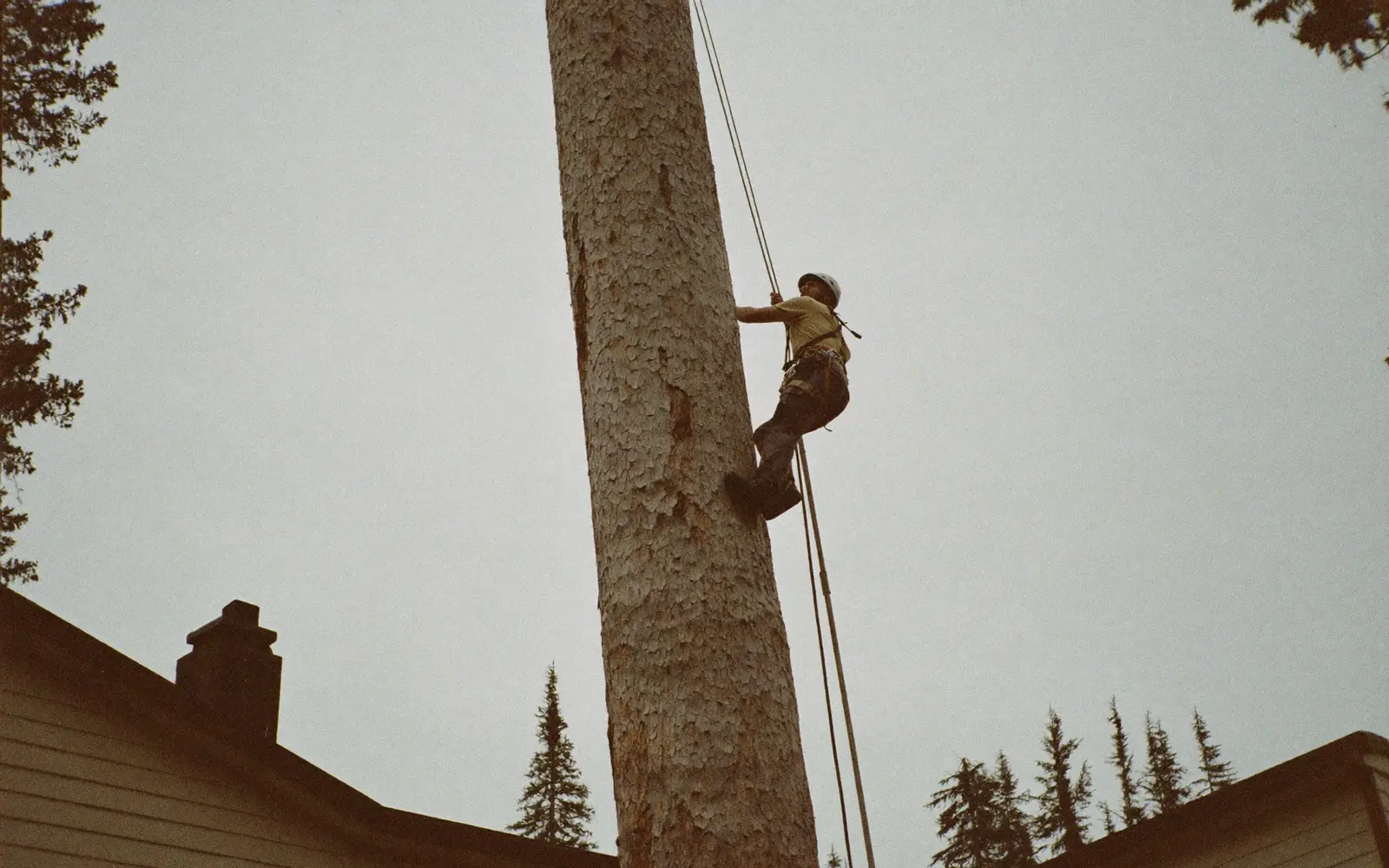
Kirkland calls any tree 26 inches or wider at 4.5 feet above the ground a Landmark tree. In much of Finn Hill, Kingsgate and Bridle Trails, the second-growth Douglas firs and western redcedars planted or left after the 1950s and 60s have grown past that size, so Landmark rules apply to more yards than people expect.
The Landmark rules in one table
| Rule | |
|---|---|
| Allowance | 1 Landmark tree per 12 months, on a lot without special conditions |
| Form | Landmark Tree Removal Permit on mybuildingpermit.com |
| City fee | $300 + 3.5% surcharge |
| Replacement | 3 trees from the Landmark Tree Mitigation List |
| Recording | $305 recording fee for the mitigation trees |
| Second Landmark in 12 months | Only as a hazard or nuisance tree, with an arborist report ($600 permit) |
| Special conditions (critical area, shoreline, HPO, covenant) | Hazard or nuisance only |
| Planning to develop | Landmark removal can block development permits for 24 months |
Before you apply
- Measure honestly. The 26-inch line is the line between free and permitted. A 25” tree goes through the free notification (if your allowance allows); a 26” tree does not.
- Choose where three new trees will go. Three trees need real space: think about the mature size, power lines, the septic or drain field and your neighbour’s view.
- Check your 12-month history. If anyone on the property removed a Landmark in the last year, this one must be a hazard or nuisance tree.
- Think two years ahead. If you might build or add more than 50% to your footprint, the 24-month development hold matters more than the fee.
Removing a Landmark tree safely
Most Kirkland Landmarks are 90 to 150 feet tall and close to houses, so they come down in sections: a climber removes limbs, then the trunk is cut in pieces lowered on ropes, or lifted out with a crane when there is no room to lower. Expect one long day for a typical Landmark fir, with stump grinding as an option. See large conifer removal for how crews handle them.
If you’d rather keep it
A big tree that only worries you can often stay. Crown cleaning, end-weight reduction and, for split trunks, cabling reduce risk without removing it. An arborist’s risk rating tells you whether keeping it is reasonable.
Measured 26 inches or more? Let's plan the removal and the 3 replacements together.
(425) 000-0000Common questions
How do I know if my tree is a Landmark tree?
Measure the trunk circumference at 4.5 feet above the ground and divide by 3.14. If the diameter is 26 inches or more, it is a Landmark tree. That is a circumference of about 82 inches, a little under 7 feet.
Can I remove two Landmark trees in the same year?
Only one per 12 months by right. A second must qualify as a hazard or nuisance tree, backed by an arborist report and a Tree Removal Permit.
What trees can I plant as Landmark replacements?
They must come from the City of Kirkland's Landmark Tree Mitigation List. Native conifers such as Douglas fir and western redcedar are typical choices where there is room; the list also includes smaller trees for tight yards.
Why is there a $305 recording fee?
Kirkland records the required mitigation trees against the property so they stay in place. The recording fee is charged on top of the permit fee whenever mitigation trees are required.